
Frida Kahlo

The Painter Who Lived Like Fire
In 1907, in the small Mexican town of Coyoacán, a little girl was born in a bright blue house called Casa Azul.
Her name was Frida Kahlo.
As a child, Frida was energetic and mischievous, but physically fragile. At the age of six, she contracted polio, which left her right leg thinner than the other. Other children teased her, but Frida refused to be defeated. She hid her leg beneath long skirts, exercised constantly, and tried with all her strength to appear strong.
She was more interested in science and medicine than art. She dreamed of becoming a doctor one day and helping people. Her family believed the intelligent young Frida would grow into a successful physician.
But fate had prepared a completely different path for her.
One afternoon in September 1925, 18-year-old Frida was riding a bus home with her boyfriend. It seemed like an ordinary day. People laughed and chatted while sunlight filled the streets.
Then suddenly—
A streetcar slammed into the bus with a horrifying crash.
The bus shattered apart. People screamed. Frida’s body was thrown through the air. A metal handrail pierced through her body, while her spine, ribs, pelvis, and legs were crushed.
People thought the blood-covered girl was dead.
Then something strange happened. A bag of gold powder carried by another passenger burst open during the crash, covering Frida’s broken body in glittering gold dust.
Later, witnesses said:
“She looked like a goddess suspended between life and death.”
Miraculously, Frida survived.
But from that day on, her life changed forever.
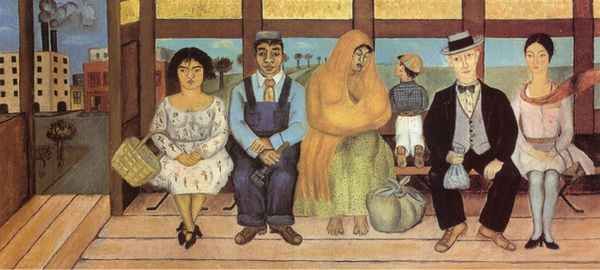
(Story) This painting "The Bus" quietly captures ordinary people from different social classes sitting together moments before the tragic bus accident that would change her life forever.
In the hospital, Frida could barely move. Her body was trapped in plaster casts, and surgeries never seemed to end. The pain was so unbearable that she often cried through the night.
Her mother placed a special mirror above her bed.
Her father brought her paints and brushes.
At first, Frida painted simply to pass the time. But slowly she realized something important:
Painting was not a hobby.
It was how she survived.
She began painting self-portraits while staring into the mirror above her bed. Tears, anger, loneliness, fear—she hid nothing.
“I paint myself because I am so often alone, and because I am the subject I know best.”
Her paintings were beautiful and terrifying at the same time. Broken bodies, exposed hearts, tears running down her face—yet surrounded by flowers, animals, and vivid colors.
As if life itself refused to disappear inside suffering.

(Story) The Dream (The Bed) shows Frida sleeping peacefully beneath a floating skeleton, symbolizing how death, pain, and fear constantly hovered over her life even during moments of rest.
Years later, Frida met the famous muralist Diego Rivera.
Diego was huge, charismatic, and already one of Mexico’s most celebrated artists. Frida brought him her paintings and asked:
“Tell me honestly—do I have talent?”
After studying her work, Diego replied:
“You are already a real artist.”
They fell passionately in love and soon married. People called them “the elephant and the dove.” Diego was massive and rough; Frida was small but fiercely intense.
But their marriage was stormy.
Diego cheated constantly. Eventually, Frida discovered that he had an affair with her own sister, Cristina. The betrayal devastated her more deeply than any previous heartbreak.
In response, Frida cut off her long hair and painted herself wearing a man’s suit.
It was as though she were saying:
“You loved the woman with long hair.
That woman is gone now.”
Still, Frida refused to live quietly or obediently. She loved freely, spoke boldly, and ignored society’s expectations of women.
Frida desperately wanted children, but the injuries from the accident made pregnancy almost impossible. She suffered multiple miscarriages and fell into deep despair.
Once again, she transformed her suffering into art.
She painted herself bleeding in hospital beds, her body broken and vulnerable. Viewers were shocked, yet unable to look away.
Her paintings no longer felt like ordinary art.
They felt like pieces of a human soul laid bare on canvas.
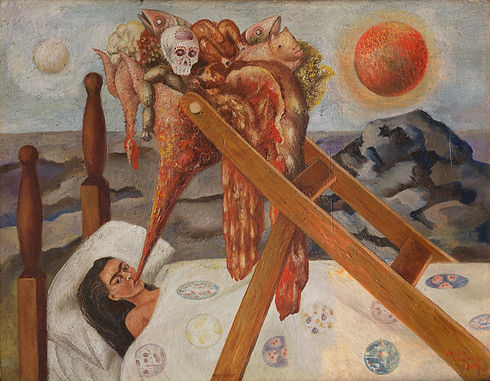
(Story) "Without Hope" portrays herself trapped in bed while being force-fed grotesque piles of meat and dead animals, expressing the physical suffering, emotional exhaustion, and loss of control she endured during her long illnesses and medical treatments.
As time passed, Frida became internationally famous. Her work was exhibited in the United States and Europe, and artists around the world admired her honesty and originality.
But her body continued to deteriorate.
The pain in her spine grew worse. She endured countless surgeries, and eventually her right leg had to be amputated.
Most people would have surrendered to despair.
Frida did not.
In 1953, her first solo exhibition in Mexico was finally held. Doctors warned her that she was too sick to leave bed.
But on the night of the exhibition, guests stared in disbelief as an ambulance arrived outside the gallery.
Frida was carried inside in her bed.
Dressed in colorful traditional clothing, she laughed, sang, drank, and celebrated with her guests while lying beneath the gallery lights.
It was as if she were declaring to the world:
“My body may be broken, but my spirit is not.”
In 1954, Frida Kahlo passed away.
But her art never disappeared.
People do not look at her paintings and see only sadness. They see courage—the fierce determination to remain fully yourself even through pain, betrayal, and suffering.
That is why Frida Kahlo is remembered not only as a painter, but as a woman who transformed her wounds into art.
